
How to Find Your Skin Undertone for a Perfect Foundation Match
Let’s solve the biggest makeup frustration together by finding your true skin undertone. I’ll show you why most advice doesn't work for South Asian skin, and how we find the perfect match that lasts through your entire wedding week.
Does your foundation ever betray you? It looks perfect in the morning. Then you catch your reflection hours later, and it seems gray, or orange, or just… off.
If this sounds familiar, you are not alone. And it is not your fault.
After 15+ years of helping brides get ready, I know that finding the right foundation is the number one thing my clients worry about. Especially for South Asian skin, the usual advice often misses the mark.
Let's make it simple.
Your Skin Has Two Dials, Not One
Think of your skin color like it has two settings.
Depth is how light or dark your skin is. Undertone is the unique tint underneath, like red, yellow, or olive green.
Most foundation mistakes happen when we try to treat these two separate things as one. A salesperson might see your skin depth and hand you a "warm" shade. But if your undertone is actually more olive or neutral, that foundation will never look quite right.
This is why a shade can be the right depth but still look wrong on you.
Why Those Home Tests Can Be Confusing
You have probably heard of a few tricks for finding your undertone. Let's look at why they might have left you feeling more confused.
- The Vein Test: Looking at the veins in your wrist is a popular tip. But for many of us, especially with deeper skin tones, our skin's pigment hides the true color of the veins. What you see is not a clear map to your undertone.6 You can safely ignore this test.
- The Sun Test: People say if you tan easily you are warm, and if you burn you are cool. This is really about how your skin reacts to sun, not its color.4 It does not give us the details we need.
- The White Cloth Test: Holding something white or off-white next to your face is actually helpful. Comparing your skin to your dupatta is even better. It helps your eyes see the tones in your skin more clearly.
Your eye is good at this, but it needs something to compare against. The best way is to see the foundation on your skin, in the right light.
Always Trust Daylight
Lighting changes everything. A foundation can look perfect under your bathroom lights and completely different in the car. The lights in a store, a hotel ballroom, or from a photographer's flash all cast a different color.9
This is our simple rule: always check a foundation in natural daylight.
Take a swatch to a window or step outside. This is the only way to see its true color. For your wedding, I will ask about your venues and your photographer. We plan for the lighting of your Sangeet, your Wedding, and your Reception, so you look beautiful in person and in every photo.
Why Your Foundation Changes Color During the Day
You are not imagining it. That shift in color you see after a few hours is real.
Many people call it "oxidation." But research suggests it has more to do with your skin's natural oils mixing with the foundation pigments.14, 16 It often happens first on the oilier parts of your face, like your nose and chin.
I see it with my brides all the time. After hours of celebrating, your skin is warmer and has produced more oil. We expect this. We choose and apply your foundation knowing it needs to look fresh for the whole day, not just the first hour.
The Challenge of Foundation for Brown Skin
Here is the truth. For years, the beauty industry did not make shades with us in mind.
Most foundations are made by mixing red, yellow, and black pigments into a white base. To create deeper shades, you take the white out. But this can make the other colors look too strong.
This is why so many foundations pull orange, red, or ashy gray on South Asian skin. If you have an olive undertone, it is even harder. You find everything is either too pink or too yellow.
It is not you. It is the limited colors in the bottle. One UK study found that fewer than one in ten foundations in stores were suitable for deep skin tones.13 Things are better now, but that history is sitting in a lot of makeup bags. The goal is to find the brands that get it right.
The Right Way to Find Your Match
Forget testing on your hand or wrist. Your face is where you will wear it. Here is the simple method we use.
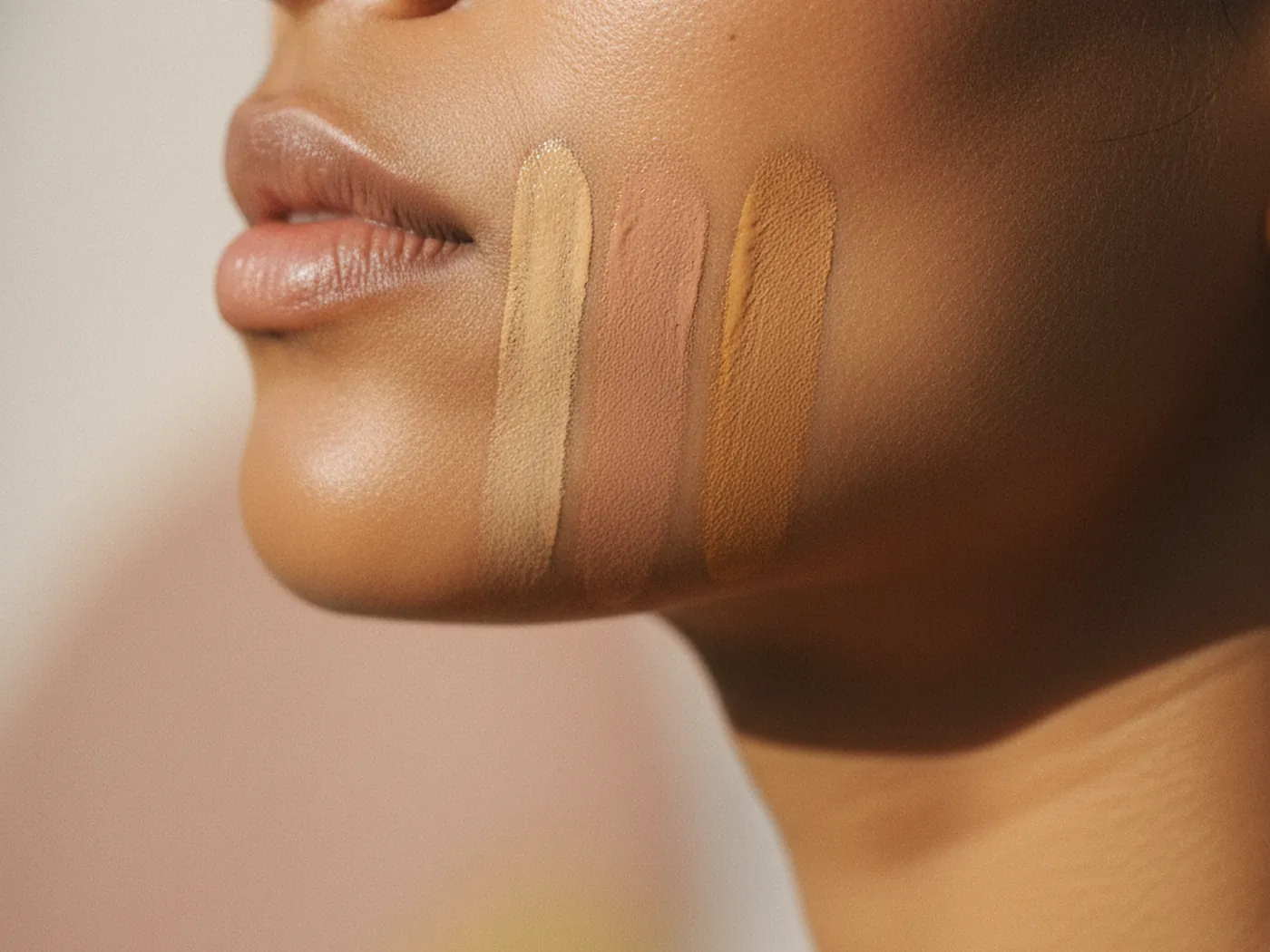
- Pick Three Shades: Choose the one you think is closest, one slightly lighter, and one slightly darker.
- Swatch on Your Jaw and Chest: Apply a stripe of each shade along your jawline. This spot connects your face and neck, where a mismatch is most obvious. I also like to check it against your chest, since this area is often a slightly different color.
- Wait and See: Let the foundation dry completely. The color can change as it sets.
- Go to the Light: Walk over to a window and look at the stripes in natural daylight. One should seem to disappear into your skin. That is your winner.
- Take a Photo: Use your phone to take a picture with and without flash. A camera often sees what the naked eye misses.
A good match should not be noticeable. It just looks like beautiful, even skin. It lets the rest of your makeup, and you, be the focus.
Matching Foundation for Your Bridal Makeup
Your skin changes with the seasons. A tan from a summer holiday can make you a full shade deeper and warmer.2, 19 The foundation I match for you in February might not be right for your July wedding.
That is why we never match just once. We will find your shade at your bridal preview, then we check it again closer to the wedding. On your wedding morning, we do one final check to make sure it is perfect.
This is how we ensure you look and feel like yourself for every single event.
The goal of all this is simple. It is for you to put on your lengha, see your family, and step into your wedding week without once worrying about your makeup.
The right foundation gives you that peace of mind.
If you have questions about your wedding, I would love to hear them. You can see how I work with brides and their families on my Bridal page or send me a message with your dates.
Our Sources
We believe in sharing what we know. Any scientific claims in this article are backed by these sources. All other advice comes from my 15+ years of experience with brides just like you.
- Optical properties of biological tissues: a review Physics in Medicine and Biology, 2013
- A long-term time course of colorimetric evaluation of ultraviolet light-induced skin reactions Clinical and Experimental Dermatology, 1999
- The colour of the human skin: fruitful science, unsuitable wordings International Journal of Cosmetic Science, 2015
- Individual Typology Angle and Fitzpatrick Skin Phototypes are Not Equivalent in Photodermatology Photochemistry and Photobiology, 2022
- Skin Phototype Classification with Machine Learning Based on Broadband Optical Measurements Sensors, 2024
- Why do veins appear blue? A new look at an old question Applied Optics, 1996
- Chromatic and luminance sensitivity for skin and skinlike textures Journal of Vision, 2019
- The effect of illumination cues on color constancy in simultaneous identification of illumination and reflectance changes Journal of Vision, 2025
- Dermoscopy and skin imaging light sources: a comparison and review of spectral power distribution and color consistency Journal of Biomedical Optics, 2022
- In multiple situational light settings, visual observation for skin colour assessment is comparable with colorimeter measurement Skin Research and Technology, 2016
- Diffuse Reflectance Spectroscopy Versus Mexameter MX18 Measurements of Melanin and Erythema in an African Population Photochemistry and Photobiology, 2016
- Quantifying Erythema and Skin Tone Variation in Cutaneous Rashes: A Colorimetric Approach Cureus, 2026
- Colour matched cosmetic foundations for black skin tones Cosmetics and Toiletries, via UAL Research Online, 2017
- Study on the factors affecting the darkening of liquid foundations Society of Cosmetic Chemists, 2022
- Research on the intrinsic mechanism of the darkening of liquid foundation Skin Research and Technology, 2023
- Investigating the impact of sebum secretion on liquid makeup foundation darkening and its solution International Journal of Cosmetic Science, 2024
- Associations Between Dietary Carotenoid Intake and Plasma Carotenoid Concentrations and Skin Yellowness, a Validation Study Journal of Human Nutrition and Dietetics, 2025
- Color difference thresholds of maxillofacial skin replications Journal of Prosthodontics, 2009
- Quantitative assessment of narrow-band UVB induced tanning during phototherapy in Korea Journal of Dermatology, 2002
- Melasma: Diagnosis and treatment American Academy of Dermatology, current
You might also like
Your Bridal Makeup Preview: A Rehearsal for a Calm Wedding Day
Your bridal makeup preview is our rehearsal for a calm wedding morning. Learn what to expect and how to prepare for this key planning session.
A Guide to Bridal Makeup for Oily Skin
Worried about bridal makeup for oily skin or dry patches? Learn how we prepare your skin and choose products to ensure a flawless look that lasts.
My Truths About Long Wear Makeup
The truths about long wear makeup: what really keeps your look in place through a long day, and what does not, from 15+ years of bridal mornings.